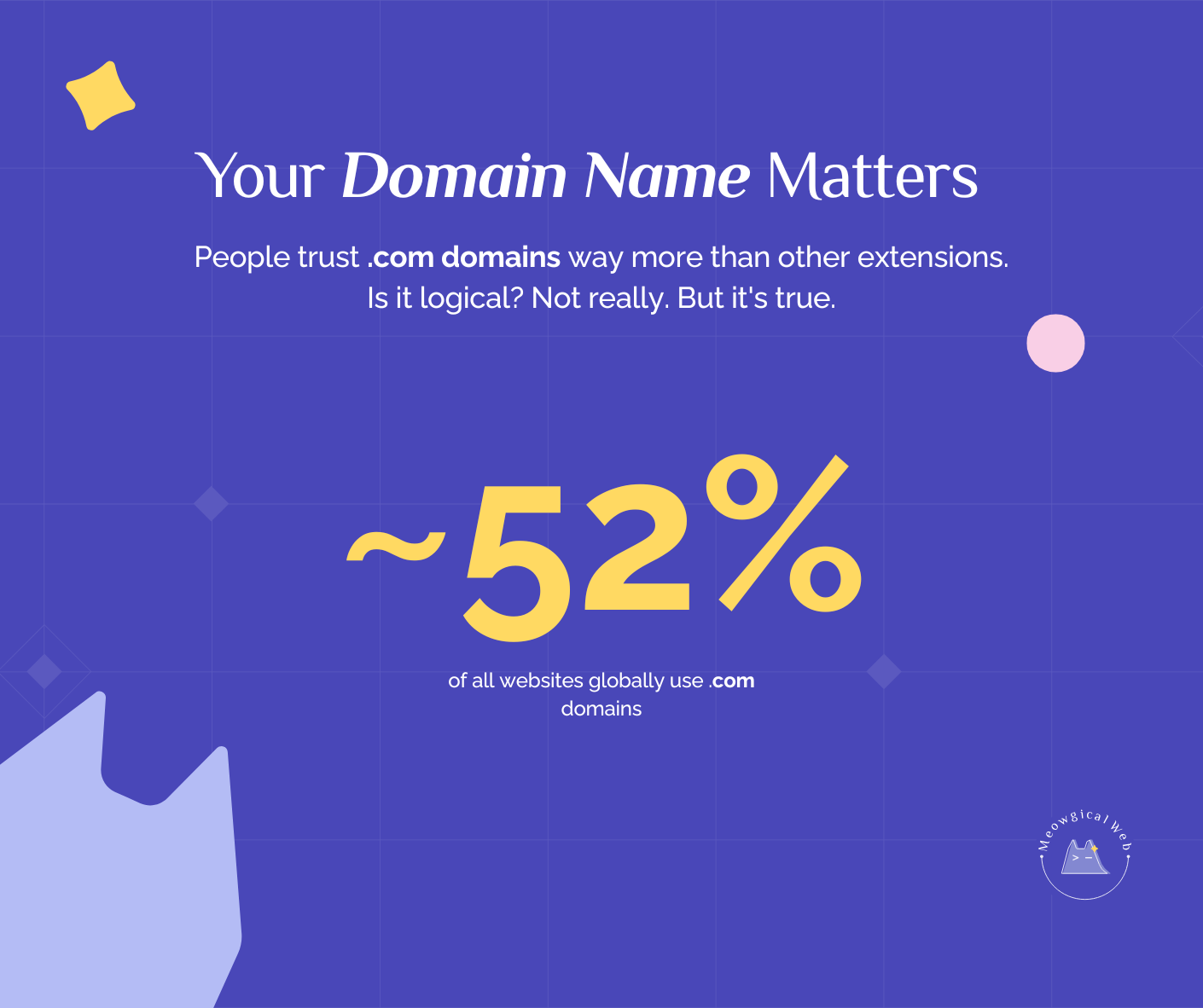
Domain extensions significantly impact how trustworthy pet business websites appear to potential clients, with .com domains receiving substantially more trust than alternatives like .net, .pet, .biz, or newer extensions despite no actual technical differences between them. In fact, approximately 52% of all websites globally use .com domains, creating deep familiarity and perceived legitimacy in people’s minds.
When ideal .com domains are unavailable, effective alternatives include adding city names for local SEO like PawsGroomingDenver.com, incorporating service descriptions like HappyPawsBoarding.com, or getting slightly creative while maintaining simplicity. However, avoid hyphens that people forget and numbers that create confusion between numerals and spelled-out words. Ultimately, effective pet business domain names should be easy to say aloud, remember without conscious effort, and type accurately without thinking.
A grooming salon was launching with the perfect business name: “Happy Paws Grooming.” They went to register their domain and discovered HappyPawsGrooming.com was already taken. Taken by someone in a completely different state who wasn’t even using it.
Their web designer suggested HappyPawsGrooming.pet instead. “It’s perfect!” she said. “You’re a pet business. The .pet extension makes total sense.”
Logically, this sounded reasonable. However, six months later, they noticed something frustrating. People kept typing HappyPawsGrooming.com and ending up at a parked domain page. Then they’d give up instead of trying different extensions.
The salon was losing potential clients because their domain didn’t match what people automatically assumed.
The .Com Trust Factor
Here’s the truth: people trust .com domains way more than other extensions. Is it logical? Not really. But it’s absolutely true.
In fact, .com has been around since 1985. It’s what people learned first when the internet became mainstream. Meanwhile, their brains automatically default to .com when remembering website addresses.
Someone hears about your grooming business at the dog park. They get home and type what they remember plus .com. If that’s not your actual domain, they land somewhere else or get an error. Most people won’t troubleshoot. Instead, they’ll just call a different groomer.
According to GrowthBadger’s domain extension trust research, .com domains are perceived as 33% more trustworthy than other extensions. Furthermore, 52% of all websites globally use .com domains, reinforcing this familiarity bias.
Similar to how missing favicons signal unprofessionalism, unusual domain extensions create subtle doubt about legitimacy.
Why Other Extensions Feel Different
Technically, .net, .pet, .biz, .org, and newer extensions all work exactly the same. Your website loads identically regardless of what comes after the dot.
However, people’s perception differs dramatically. .Net feels tech-focused. .Org signals nonprofits. Meanwhile, .biz feels outdated and spammy. .Pet feels novelty rather than established.
A veterinary clinic chose VetCare.clinic for their domain. The .clinic extension seemed perfect for a medical practice. Unfortunately, clients constantly forgot the extension. They’d type VetCare.com and end up confused when they couldn’t find the website.
The clinic eventually bought VetCare.vet as well and redirected it to their .clinic domain. Then they bought VetCare.com from the domain squatter for $800. Ultimately, they should have just started with .com.
What To Do When .Com Is Taken
Your perfect domain is taken. This happens constantly. Fortunately, you have several smart alternatives that maintain .com trust.
Add your city or region to the domain. For instance, if HappyPawsGrooming.com is taken, try HappyPawsGroomingDenver.com or HappyPawsDenver.com. This actually helps with local SEO. Furthermore, it clarifies your service area immediately.
A mobile groomer wanted MobileGrooming.com. Obviously taken. Instead, she registered MobileGroomingAustin.com. This worked perfectly because her business was entirely local anyway. In addition, it helped her rank better for Austin-specific searches.
Add what you do to the domain. If PawsAndClaws.com is taken, try PawsAndClawsBoarding.com or PawsAndClawsVet.com. This makes your services clearer immediately.
For example, a multi-service pet business wanted PetParadise.com. Taken by a major chain. Instead, they used PetParadiseDaycare.com. This actually communicated their primary service more effectively than the generic name would have.
Get slightly creative with wording, but keep it simple. If BlueDogGrooming.com is taken, maybe BlueDogGrooms.com or BluePoochGrooming.com works. However, don’t get too creative or you’ll confuse people.
The Problems You Should Avoid
Hyphens seem like an easy solution. Happy-Paws-Grooming.com is probably available. Unfortunately, people always forget hyphens when typing domains. They hear your business name and type it without hyphens. Then they end up at the wrong place or nowhere.
A training facility made this mistake with Best-Dog-Training.com. Every single time someone heard their name verbally, they typed BestDogTraining.com. That domain belonged to a competitor in another state. The training facility was literally sending free traffic to competitors.
Numbers create similar confusion. Is it Paws2Groom.com or PawsToGroom.com? When someone hears your business name, they don’t know if “to” is the word or the number 2.
A boarding facility called “4 Paws Boarding” registered 4PawsBoarding.com. However, half their clients typed FourPawsBoarding.com and couldn’t find them. Eventually, they bought both domains and redirected one to the other. This cost extra money and created unnecessary confusion.
Unusual spellings also backfire. Kute-K9-Klips.com might seem fun and memorable. In reality, people struggle to remember the creative spellings. Meanwhile, they default to typing CuteCanineClips.com or something more intuitive.
The Say-It-Out-Loud Test
Before committing to any domain, say it out loud to someone. Can they type it correctly without seeing it written?
A grooming salon almost registered PawsitivelyPerfectPets.com. It looked fine written down. However, when they said it aloud to friends, everyone asked “Wait, how do you spell ‘pawsitively’?” The confusion wasn’t worth the clever wordplay.
Instead, they chose PositivePawsGrooming.com. Less clever, but infinitely easier to communicate verbally.
Similarly, avoid anything that sounds unclear when spoken. “Fur-Ever Friends” could be typed as ForeverFriends.com, FurEverFriends.com, or FureverFriends.com. Too many variables.
The Memory Test
Someone meets you at a networking event. You mention your website. Can they remember it three days later without writing it down?
Short domains win this test. PawsAndClaws.com beats PawsAndClawsPetCareCenterAndBoarding.com every single time. Furthermore, simple words beat creative spellings. Meanwhile, .com beats any other extension.
A pet sitting service registered TheBestPetSittingServiceInChicago.com. Technically it worked. However, absolutely nobody remembered the full domain. They’d get home and type random variations, rarely getting it right.
They eventually rebranded with a shorter business name and ChicagoPetSitters.com. Bookings increased because people could actually find their website after hearing about them.
When To Buy Multiple Domains
Sometimes buying several related domains makes sense. For instance, if your business name is “Happy Tails,” you might buy HappyTails.com, HappyTailsBoarding.com, and HappyTailsDenver.com. Then redirect the extras to your main site.
This prevents competitors from grabbing similar domains. Furthermore, it catches people who type variations of your name.
A grooming business called “Pampered Paws” bought PamperedPaws.com as their main site. However, they also bought PamperedPawsGrooming.com and PamperedPawsSalon.com. All of these redirect to the main site. When clients type any variation, they end up in the right place.
This costs about $30-40 annually for the extra domains. For most businesses, that’s worthwhile peace of mind.
The Social Media Username Connection
Ideally, your domain name matches your social media handles. If you’re PawsAndClawsBoarding.com, you want @PawsAndClawsBoarding on Instagram and Facebook.
Before finalizing your domain, check if matching social handles are available. Sometimes a domain is free but the Instagram handle is taken. This creates branding inconsistency.
A training facility registered K9TrainingPros.com. Perfect domain. Unfortunately, @K9TrainingPros was taken on Instagram by an inactive account. They ended up using @K9TrainingProsOfficial on social media, which felt clunky and confusing.
Checking social media availability first could have prevented this mismatch.
Making The Switch If Needed
Already have a domain you’re unhappy with? You can change it, though there are considerations.
If you’re brand new with minimal traffic, switching is relatively painless. Simply register the new domain and launch there instead.
However, if you’ve been around a while with established traffic and SEO rankings, switching requires more care. You’ll need proper redirects from your old domain to your new one. Furthermore, you might see temporary SEO impacts during the transition.
A boarding facility switched from PetResort.biz to PetResortBoarding.com after two years. They kept paying for the .biz domain and set up permanent redirects. This way, anyone typing the old domain still reached their site. Meanwhile, they gradually built SEO authority on the new domain.
The Investment That’s Worth It
Premium domains—those already registered by someone else—can be expensive. Some domain squatters ask thousands for desirable names.
Sometimes this investment makes sense for a perfect, memorable .com. Other times, it’s smarter to choose a good alternative for $12 annually than pay $5,000 for someone’s held domain.
A veterinary practice wanted AnimalClinic.com. The owner wanted $8,000 for it. Instead, the vet registered AnimalClinicDallas.com for $12. That saved money worked better spent on actual marketing.
Conversely, a grooming salon paid $2,000 for their exact business name as a .com domain. For them, the brand consistency and memorability was worth the upfront cost.
What Actually Matters Most
Your domain should be easy to say out loud. Easy to remember. Easy to type correctly without thinking. Furthermore, .com builds more automatic trust than alternatives.
If your perfect .com is available, grab it immediately. However, if it’s taken, smart alternatives with .com still work infinitely better than settling for unusual extensions.
What’s your domain right now? Say it out loud. Would a stranger type it correctly? Does it include hyphens or numbers that create confusion? Is it .com or something else?
If you’re just starting out, invest extra time finding the right domain. Meanwhile, if you’re already established with a problematic domain, consider whether switching might benefit your long-term growth.
Your domain is often the first thing people type to find you. Make it count.